

Design Tips
How Global Conflicts Are Reshaping the Home Decor Industry And What It Means for Your Home in 2026
March 29, 2026
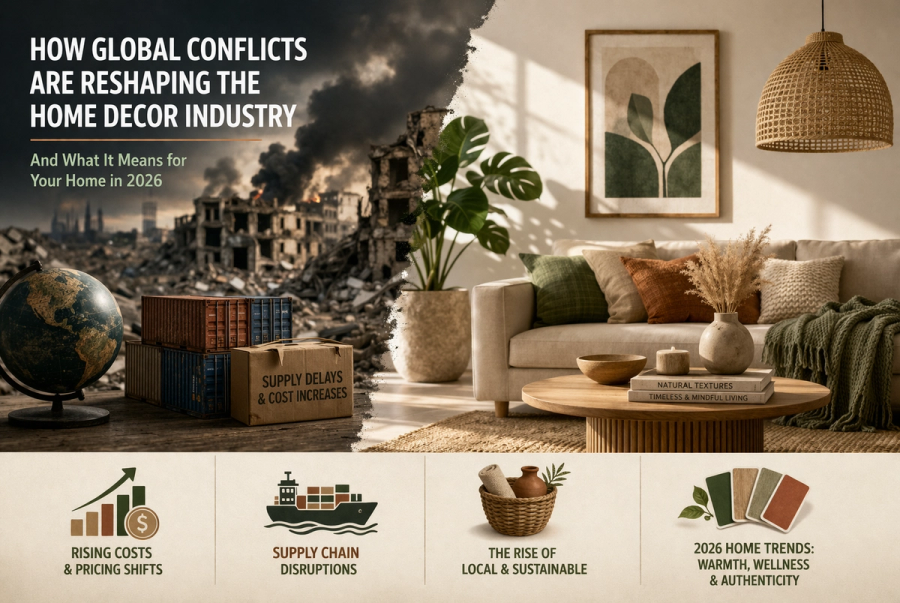
War is not something we typically associate with interior design. Yet the ripple effects of global conflicts from the ongoing Russia-Ukraine war to escalating tensions across the Middle East are quietly but significantly reshaping the home decor and interior design industries worldwide. If you have noticed that certain materials are harder to find, that prices have shifted unexpectedly, or that design trends seem to be moving toward something more grounded and inward-looking, you are not imagining it.
At Decorezzy, we believe that understanding the world around us makes us better, more intentional decorators. So today, we are breaking down exactly how global conflicts are affecting your home and what you can do about it.
The Supply Chain Impact Where It All Begins
The most immediate and measurable effect of global conflict on the home decor industry is the supply chain. When Russia invaded Ukraine in 2022, the world lost access to two of its most significant sources of raw materials almost overnight.
Ukraine is one of the world's largest producers of timber, iron, and steel. Russia supplies a significant portion of the world's aluminum, nickel, and copper all materials used extensively in furniture manufacturing, lighting fixtures, hardware, and decorative metal pieces.
The result was immediate. Metal furniture prices climbed. Certain wood species became harder to source. Manufacturers who had built their entire supply chains around Eastern European materials scrambled to find alternatives.
For consumers this translated into something very practical the home decor piece you ordered in January might arrive in April. The price you saw last month might not be available today. And the exact finish or material you wanted might simply not be in stock.
This is not a temporary blip. Supply chain disruption of this scale reshapes industries for years.
The Middle East Conflict Energy, Shipping and Cost
The escalating tensions involving Iran, Israel, and broader instability across the Middle East have added another layer of disruption this time to energy costs and international shipping.
The Red Sea shipping routes, which carry a significant portion of global trade between Asia and Europe, have been severely disrupted. Many shipping companies have rerouted vessels around the Cape of Good Hope instead adding weeks to delivery times and thousands of dollars to shipping costs per container.
For the home decor industry, which relies heavily on manufactured goods from China, Vietnam, India, and Southeast Asia reaching European and American markets, this has been deeply consequential. Longer shipping routes mean higher fuel costs, higher container costs, and ultimately higher retail prices.
In India specifically, the effect has been felt in the cost of imported raw materials certain resins, specialized hardware, high-quality glass, and specific fabric dyes that come from European or Middle Eastern suppliers have become more expensive and harder to predict in terms of availability.
At Decorezzy, this has reinforced our commitment to locally sourced and handcrafted products not just as an aesthetic choice, but as a genuinely resilient supply chain strategy.
The Design Philosophy Shift Nesting in Uncertain Times
Beyond the supply chain, global conflict creates a profound psychological effect on how people relate to their homes.
Research in environmental psychology consistently shows that during periods of global instability, people invest more in their homes. The home becomes a sanctuary a space of safety, control, and beauty in a world that feels increasingly unpredictable. This phenomenon is sometimes called nesting and it has been observed in every major period of global instability in modern history.
During the COVID-19 pandemic we saw it clearly home decor sales surged globally as people turned their attention inward. The same pattern is emerging now. People are spending more thoughtfully on their living spaces. Not on impulse purchases, but on pieces that feel meaningful, durable, and genuinely beautiful.
This is actually an opportunity for conscious consumers. Uncertainty forces intentionality. When you cannot buy everything, you choose better.
The Rise of Local and Artisan India's Moment
One of the most significant design shifts emerging from global supply chain disruption is a renewed appreciation for locally made, artisan-crafted home decor.
When global supply chains break down, local craftsmanship becomes the most reliable alternative. And in India, we are fortunate to have one of the richest traditions of handcraft in the world from Rajasthani woodwork to Bengali kantha textiles, from Kerala cane furniture to the resin art traditions being built by a new generation of Indian makers.
This is India's moment in the global home decor conversation. As Western markets scramble to replace disrupted supply chains, Indian artisans and manufacturers are stepping into a significant gap and Indian consumers are increasingly recognizing the value of what is made right here at home.
At Decorezzy, every piece we offer is handcrafted in India. Not because it is a trend, but because we believe Indian craft is genuinely world-class and because local sourcing means we can stand behind the quality, the ethics, and the availability of every product we sell.
Material Scarcity What It Means for Design Choices
Global conflict-driven material scarcity is also subtly influencing which materials are trending in interior design.
When traditional materials become expensive or unavailable, designers and consumers naturally migrate toward alternatives. This is why we are seeing a surge in interest in:
Bamboo and sustainable Indian hardwoods as alternatives to imported timber. Terracotta and clay abundant, locally produced, and experiencing a genuine design renaissance. Handwoven natural textiles jute, cotton, khadi as alternatives to synthetic fabrics with disrupted petrochemical supply chains. Resin art created from locally available materials, infinitely customizable, and increasingly recognized as a serious art form.
This shift is not a compromise. In many cases, the alternative materials are more beautiful, more sustainable, and more meaningful than what they replaced.
The Psychological Design Response Creating Calm in Chaos
When the world outside feels volatile, the interior design world responds with calm. This is not a coincidence it is a deeply human response.
We are seeing this in the dominant design trends of 2025 and 2026. Quiet luxury. Biophilic design. Warm neutrals. Natural materials. Spaces that feel grounding, safe, and deeply comfortable.
These are not just aesthetic preferences. They are psychological needs expressing themselves through design choices. When geopolitical headlines are overwhelming, people come home and reach for the linen throw, the wooden tray, the handcrafted ceramic vase. They light a candle. They add a plant. They make their corner of the world beautiful and controllable.
This is one of the most profound things interior design can do not just make a space look good, but make the people inside it feel genuinely well.
What This Means for You Practical Advice for 2026
Understanding these macro forces gives you a significant advantage as a home decorator. Here is what we recommend:
Buy local where possible. Not just for ethical reasons though those matter but because local supply chains are simply more reliable in a disrupted world. A handcrafted piece from an Indian maker will reach you faster, with more predictable pricing, and with a story you can actually trace.
Invest in fewer, better pieces. Supply disruption has pushed prices up across the board. The response is not to stop decorating it is to be more selective. One genuinely beautiful piece will outperform three mediocre ones in every way.
Choose timeless over trendy. In uncertain times, pieces that will still feel right in ten years are a wiser investment than pieces chasing a trend that may be gone in two. Natural materials, classic forms, and artisan quality are always timeless.
Embrace what India makes. The world is discovering what we have always known Indian craft is extraordinary. This is a moment to celebrate and invest in it.
A Final Thought Beauty as Resistance
There is something quietly radical about making your home beautiful when the world is in conflict. It is an act of affirmation a statement that life, warmth, and beauty matter even when especially when the news is difficult.
Your home is your sovereignty. The choices you make within it the colors, the textures, the objects you surround yourself with are entirely yours. In a world where so much feels out of control, that is not a small thing.
Decorate intentionally. Buy thoughtfully. Choose beauty on purpose.
That is what Decorezzy is here to help you do.